تأثير الذكاء الاصطناعي على اتخاذ القرار الإداري
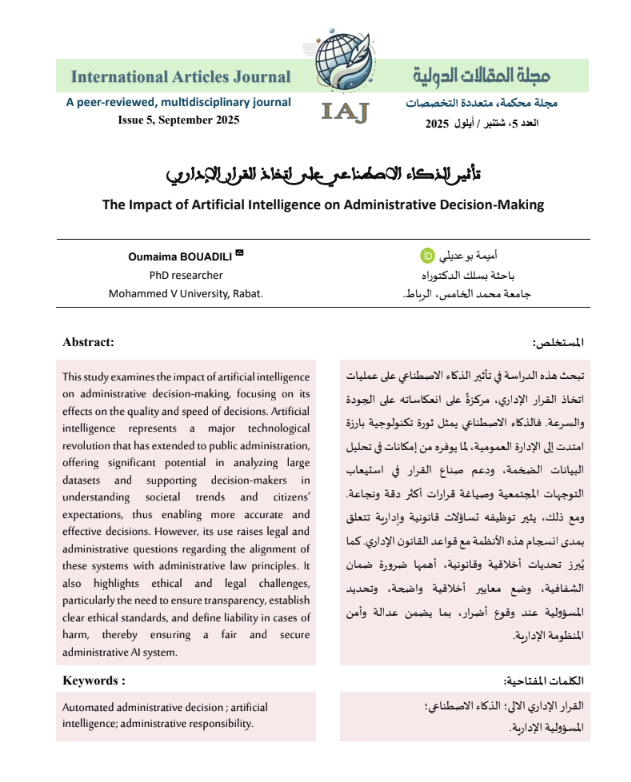
The Impact of Artificial Intelligence on Administrative Decision-Making
Artificial Intelligence (AI) is revolutionizing the way organizations make administrative decisions. The impact of AI on administrative decision-making is profound, offering opportunities to enhance efficiency, accuracy, and transparency in public and private sector operations.
AI technologies, such as machine learning, predictive analytics, and intelligent automation, are increasingly used to analyze large datasets, identify patterns, and support strategic decision-making. For government agencies, AI can streamline processes like permit approvals, tax assessments, and public service delivery, reducing human error and speeding up bureaucratic procedures. In the corporate sector,

AI improves operational efficiency, risk management, and human resource planning.
However, the adoption of AI in administrative decision-making also raises critical challenges. One major concern is accountability. When AI systems make errors or biased decisions, it is crucial to determine who is responsible—the software developer, the organization deploying the system, or the AI itself. This issue intersects with legal, ethical, and civil liability considerations.
Another key challenge is transparency. AI algorithms, especially deep learning models, often operate as “black boxes,” making it difficult for decision-makers and the public to understand how conclusions are reached. Ensuring transparency and explainability is essential to maintain public trust and meet regulatory requirements.
The impact of AI also extends to cost reduction and productivity enhancement. Automated decision-making reduces manual administrative tasks, allowing employees to focus on strategic and creative work. Moreover, AI-driven insights help organizations make data-informed decisions, improving overall organizational performance.
In conclusion, the impact of artificial intelligence on administrative decision-making is transformative. While AI offers significant benefits such as efficiency, accuracy, and reduced operational costs, it also requires careful attention to accountability, transparency, and ethical considerations. Governments, businesses, and policymakers must develop frameworks and regulations to ensure AI technologies are deployed responsibly and effectively.
Keywords for AdSense optimization: Artificial intelligence in administration, AI decision-making, AI in government, administrative efficiency, AI transparency, AI accountability, machine learning in management, intelligent automation, AI impact on productivity, ethical AI use.